Flag Day 2026 on the Dr. Smiley Show
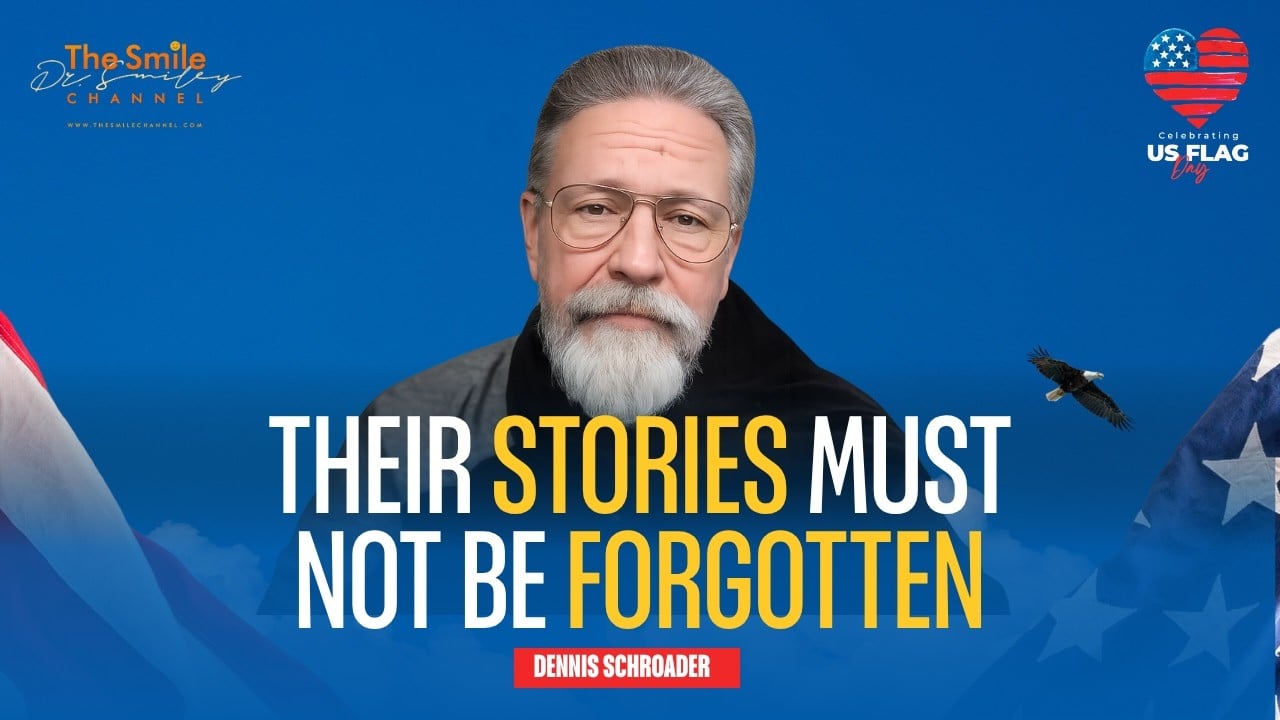
Watch the Interview: Dennis Schroader | Preserving The Stories Freedom Leaves Behind | US Flag Day 2026
Chapter 1: Jodi reflects on love for the flag
All right. So, we have had some amazing amazing people on here today. I am just like, so, you know, being a veteran, right, I sometimes feel like, especially with how the media shows things these days, I almost feel like uh that I'm the only one that loves the flag anymore. And today has proven to me once again like God always does. No babe, this is my story. This is you're not the only one.
And I am just so reassured and so I'm energized by today and and hearing all these stories and and you know my point of view is only one. Look at all these stories that we're hearing and we're only getting a slice of those stories of that go across our great nation. So I have children all these different angles. I never thought about half of these angles these people are going with the flag. I'm like sitting here going, "Well, that's a cool way to look. I'm telling a story about the flag. They got they got some meat in their stuff. I'm I'm enjoying it."
Yeah. Yeah. Some really great stories.
All right. So let's bring up our next speaker. Um, retired Army Lieutenant Colonel. So now it's gonna be two Army, one Navy. Okay. Dennis Schroeder. Dennis.
Chapter 2: Welcoming Dennis Schroader
I think you have a little bit about him, R.J. Go ahead.
I do have a little bit about Dennis. Uh, well, and is he up there yet? Hi, Dennis. How are you?
Well, he's the founder of Well, thank you.
Yeah. Founder of the Price of Freedom Foundation, which I think he's going to tell us a little bit about today, which you and I were learning. It's gonna be It's amazing what he's doing.
Yeah. I really liked hearing the beginning and talking to Dennis earlier about what his project is and how uh encompassing it is and and my big thing and it's Dennis's too. We want to hear your story. Got to tell your story.
Don't take it with you. It's gone when you're gone. And Dennis, I'm leaving it up to you because that is a great thing you're doing.
Chapter 3: Growing up in a Navy family
All right. Thank you so much. Well, you know, you we're talking about Flag Day, and my my story about the American flag really goes back to the very beginning of I was born into a Navy family. My father served 20 years in the Navy. He was enlisted. He was a machinist mate. I grew up around the American flag, being flown on on the the the ships and around the the bases and and the like. And I I grew up moving around a lot. But uh you know the American flag was always a part of that that sense of of being proud of the the country and what we were doing uh and the like.
Um and for me too I wanted I really wanted to join the Navy. Uh that's what I wanted to do because of my follow in my father's footsteps.
Uh but he suggested because I was getting great grades in high school I should try to become an officer to have a better life. Uh so I applied for RTC scholarships. Turns out I have uh defective color vision. And so back in the 70s, the Navy said, "Here's a four-year ROTC scholarship, but you have to take the Marine option." And so I was crushed. And so, uh, I chose the Army, uh, which offered me a scholarship with no strings attached and became a medical service corps officer.
And live, uh, served a total of 24 years. Uh it was uh actually from 78 to 2000 then was retired for 11 years and was asked to come back for two uh which I did 2011 to 2013.
But well Dennis, real quick. Hey, I'm gonna I'm gonna get you I want to get you back to your uh the book you wrote and all that, but I just want to let you know I taught ROTC for 14 years.
Good for you. Excellent. I loved it.
But I want to hear your story, man. That the floor is yours. Yeah, we're gonna give you the floor.
Okay. So, um it wasn't until after I had retired essentially for the second time that uh I was seeing some things that were going on in in the country. I had grown up in the the 60s and 70s and felt uh the the how the country turned away from uh its veterans and saw in the 80s and 90s how that had preversed and I was really happy about that. After 911, I saw that there were actually publications that I never thought I'd see a positive story about a veteran uh in talk about them, but they focused on one person and it just and I was happy on one on one hand and sad on the other because there were other soldiers uh in those stories that they were talking about who had died in those conflicts who went home and flag draped coffins that would get almost no recognition for this and um you know there's there's it just bothered me that we had the ability to uh to do research and to uh to tell the stories to gather those stories uh and to bring them together uh so that the families of the fallen would uh would not be forgotten.
Uh I mean as it is right now um what happens when a soldier passes uh we have the c the the the the ceremonies where uh we commemorate them and their sacrifice that they made. We uh we honor their their lives. We honor the sacrifice and then we go home and each individual carries a piece of that person's memory uh with them. And as as time goes on, those memories fade. Uh and as each other person passes away, then that piece of the story is gone forever.
Um so what we do is we offer to the families of the fallen uh our services at no cost to them to uh research their loved ones story. uh we want to go back all the way uh to the beginning from childhood on to uh to uh tell the story of how they were as a person, how they were as a child, what sort of things excited them, what were the things that they that scared them.
Chapter 4: Preserving memories before they fade
What were the things that they uh did well at? What did they struggle with? How did they impact the people around them? Who influenced them? What made them uh choose the military? uh what was their were their experiences in the military.
What of course we're going to talk about what it was that that uh cost them their lives. But we also want to know what was the impact on other people around them with that sacrifice. We want to bring all that together um into a single book uh that we present then to the family so that they can pass this on for future generations that that story is collected, is brought together and it is able to be passed down.
We also record every interview that we do so that when we have the resources to do it, we can tell that story in video format. Because one of the most common problems that military survivor families have is that after a year or two after the loved one has passed, they have the sense that outside that family and small circle of friends uh that their loved ones forgotten and their sacrifice is no longer honored.
Even those who had bridges and roads and buildings named after them. So we believe that by telling that story uh to a wider audience than they can reach, we can help mitigate that. We can never replace that. We can never uh completely eliminate that, but we can mitigate that specific problem. So that's the commitment that we have with this. It's a commitment that I have.
Um and telling the stories of those who are no longer with us are much more challenging and much more difficult. Uh but I uh want to echo what I've heard here uh earlier uh today and I know that Dr. Smiley is all about is tell the story. Tell your story while you're here, while you're able to do so.
I encourage all my uh veteran uh friends to to do that. Um and in fact the gentleman who was the writer for our first book um he had uh he'd been a uh Air Force Academy grad had spent his active duty time as a criminal investigator uh for the Air Force and he had written a couple of books uh prior to to joining us and taking on this project. He was encouraged to write his own story afterwards because he saw through this the value of telling the story. You we don't see ourselves as heroes. I never saw I don't see myself as a hero. You know, I'm just an American citizen, blessed by God to be here. Uh blessed to to be in America.
Um and yet I know my story uh will affect people that I don't even realize in ways I don't even realize. And it's the same of true that's true of you. So, uh, I do want to encourage folks to tell their story, to be proud of being an an American citizen in the greatest land that I know of.
Um, and I'm just thankful that we set this side this day to um, you know, for Flag Day to to acknowledge that. And um, I guess that's it in in a nutshell.
Hey, sorry. Did I not go long enough?
No, no, no, no, no. It was me. It was a technical issue. We're just going to do the It's It's Zoom's fault. We got shirts that we're going to put. It's Zoom's fault.
Okay.
It was all me. It was all me. No, that was really good. Thank you so much for coming on and telling us a little bit about what you do and why you do it. And I am of the same mindset. I talk all the time. People are like, "Well, should I thank a veteran?" Well, yeah, thank a veteran. But just know that we feel weird.
We realize we're doing something that most people don't do. We get that, right?
But it also is weird to say, "Thank you for your service to us." Because we don't see ourselves as a hero. We don't see ourselves. we're just there doing something that we said we would do.
So, um I completely understand um that point of view and how you said that. So, thank you for coming on and sharing that with us today.
Chapter 8: How to connect with the foundation
Well, you're very welcome, Jody. I feel honored to to have been invited to be a part of this. So, and right back at you. Um h um
\[clears throat] did you mention I didn't catch it if you mentioned how we can get a hold of you or share stories with you.
Okay. So we um the organization is called the Price of Freedom Foundation.
Uh you can find us on our website is https://priceofreedomfoundation.org
take the the off uh but if you look on social media on Facebook, LinkedIn, YouTube, Instagram, if you search for the priceof freedom foundation, uh you will find us. And um we're probably uh other than our website, we're probably most active on Facebook and you reach us at info at priceofreedomfoundation.org.
Um and uh phone number is 615-389-1867.
Perfect.
And I'm going to connect with you on social for sure. Yes, absolutely. I am too. I am too. Very good. Go ahead, Dave.
We love to We want to We want to get more stories told. We're small. Uh this is a huge vision. Uh I'm getting older.
Time, you know, time is not slowing down. So, we want to to to uh engage as many people as we can in the project because I think it's very worthwhile.
Yeah, absolutely.
It was very well presented today. You you gave a ve very good presentation. I love your voice. You keep charging. Thank you so much. Thank you, sir.
Thank you so much.
All right. God bless you guys. Have a good rest of your day.